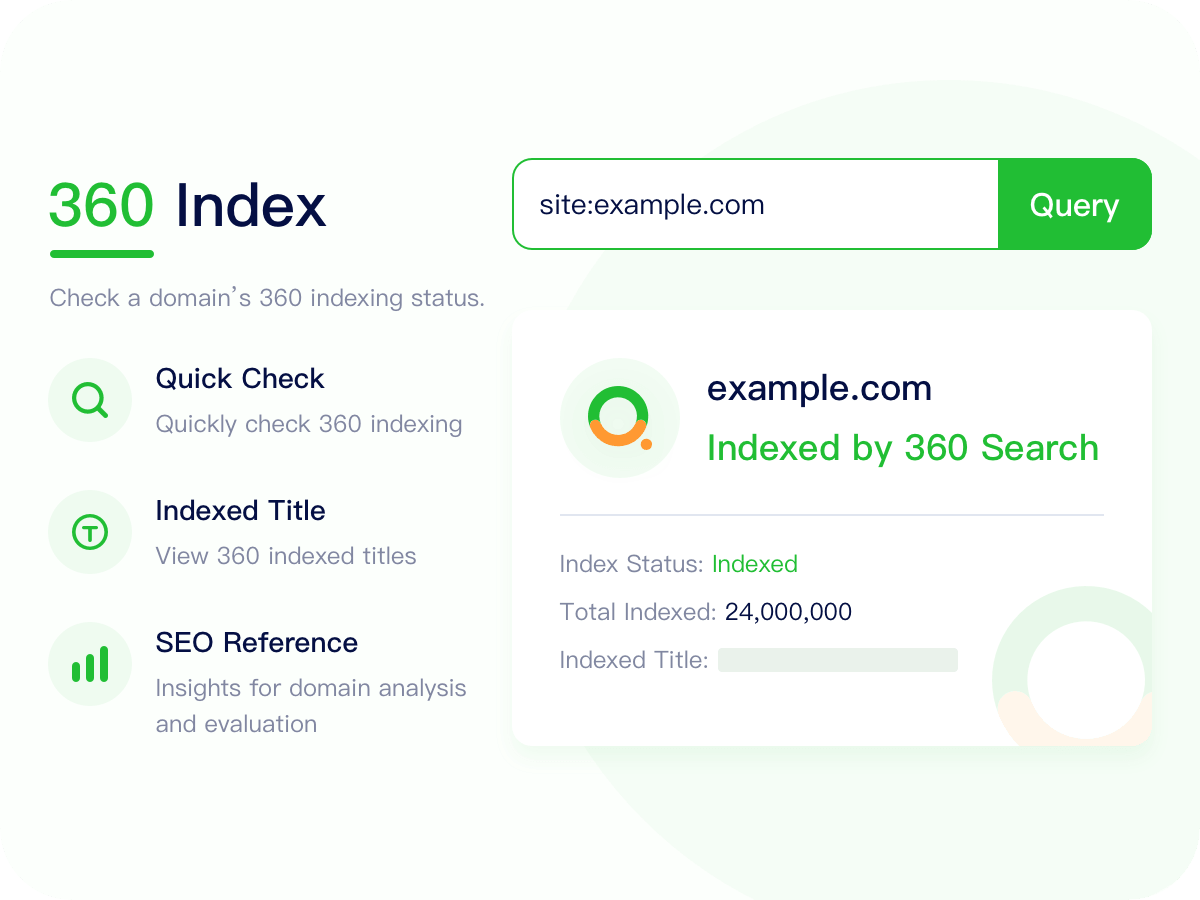

360 Indexing
Check the number of pages indexed by 360 Search to quickly understand how much of a website’s content has been discovered and indexed, providing valuable data for SEO optimization and domain analysis.
Frequently asked questions
1. Publish high-quality, original content consistently; 2. Optimize your website structure and ensure pages are easy for search engines to access; 3. Submit your website’s sitemap; 4. Check that your robots.txt file allows search engine crawlers to access your pages; 5. Keep your server stable and accessible.
The number of pages indexed by 360 only indicates how many pages from a website have been indexed by the search engine. It does not directly reflect keyword rankings or website authority. Search rankings are also influenced by factors such as content quality, user experience, and page relevance.
Having content on your website does not guarantee that it will be indexed by search engines. Indexing can also be affected by factors such as website structure, content quality, crawlability, duplicate content, and domain history.
Yes. Search engines continuously update their index data. The number of indexed pages may change as a website adds, removes, or updates pages.
The decrease may be caused by the following factors: 1. Search engines have reevaluated the quality of your pages; 2. Some pages have been deleted or are no longer accessible; 3. Server issues have prevented search engine crawlers from accessing your website; 4. Some pages are set to prevent search engine indexing; 5. Search engines have updated or adjusted their index data.
Yes. The number of pages indexed by 360 can be used as one of the reference metrics for domain SEO analysis and valuation. However, it’s recommended to consider other factors as well, such as domain history, indexing data from other search engines, keyword rankings, and backlinks.